 EN
EN AR
AR RU
RU ZH
ZH FR
FR ES
ES
June 26, 2026 • By KWD
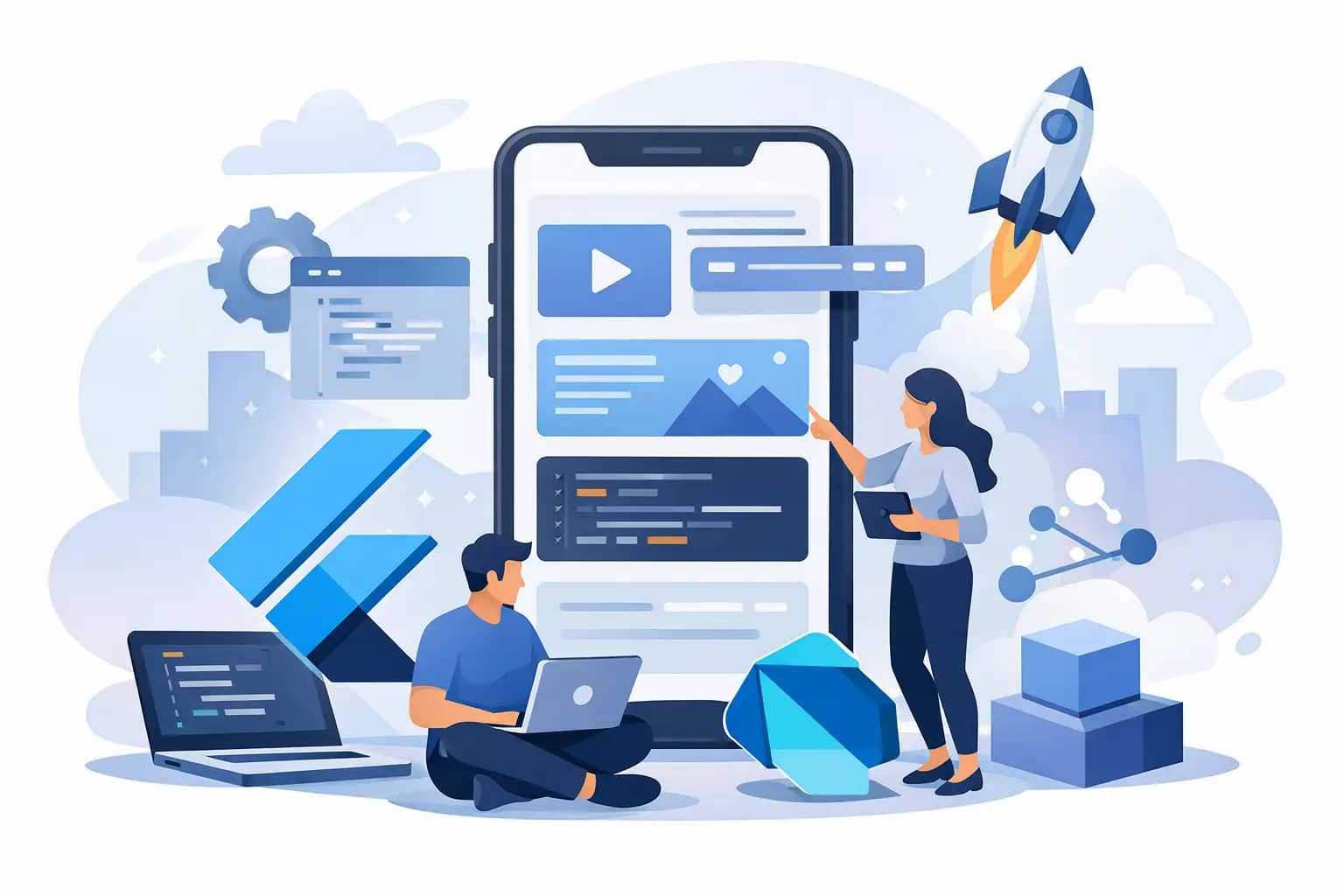
Flutter with Dart is a framework enabling businesses to build iOS and Android apps from a shared codebase, reducing costs, accelerating time to market, and maintaining consistent user experience across platforms.
Key Takeaways
- Flutter uses one codebase for iOS and Android, reducing duplicated effort and development overhead compared to separate native apps.
- Dart supports fast iteration and productive development, allowing teams to test, refine, and resolve issues without slowing project timelines.
- Flutter excels for customer-facing apps, e-commerce, booking platforms, loyalty apps, and internal tools when properly planned and engineered.
- Success depends on clear business strategy, architecture, integrations, and post-launch support, not framework choice alone.
- Flutter is cost-efficient and maintainable for SMEs and enterprises seeking cross-platform consistency without managing two separate codebases.
A business app usually fails long before launch - when the build strategy is wrong. If you need mobile app development with flutter dart ios and android support, the real question is not just which framework is popular. It is whether your business can launch faster, control cost, maintain quality, and keep improving the product without managing two separate codebases.
For many companies, Flutter with Dart is the practical answer. It gives businesses a way to build high-quality applications for iOS and Android from a shared codebase while still delivering polished interfaces, solid performance, and room for future expansion. That matters when speed, consistency, and long-term maintainability affect revenue, customer retention, and internal efficiency.
Why mobile app development with Flutter Dart for iOS and Android is gaining traction
Business leaders are under pressure to do more with digital products. Customers expect mobile convenience, teams expect better internal tools, and management expects measurable return on technology investments. Building two completely separate native apps can still make sense in some cases, but it often creates higher costs, longer timelines, and added maintenance overhead.
Flutter changes that equation. It allows developers to create a single application foundation that runs on both iOS and Android. Instead of funding two largely separate development tracks, businesses can invest in one coordinated product strategy. That usually leads to faster delivery, more consistent user experience, and simpler release management.
Dart, the language behind Flutter, also plays an important role. It is designed for productive development and supports fast iteration, which helps teams test features, refine interfaces, and resolve issues without slowing the entire project. For companies launching a new service, modernizing customer engagement, or digitizing operations, that agility can make a real business difference.
What Flutter is actually good at
Flutter is a strong fit for many commercial app projects because it combines visual flexibility with efficient development. Customer-facing apps, e-commerce experiences, booking platforms, loyalty apps, service dashboards, and internal business tools can all perform well in Flutter when they are planned and engineered properly.
Its UI system is one of its biggest advantages. Brands that care about design consistency across devices benefit from Flutter because the interface behaves predictably across platforms. This is useful for businesses that want a premium feel without rebuilding the same screens twice.
It is also well suited for MVPs and phased rollouts. If a company wants to launch core features first and expand later, Flutter supports that approach efficiently. A business can release to both major mobile platforms, gather user feedback, and refine the roadmap without carrying unnecessary technical complexity from day one.
That said, Flutter is not the right answer for every app. Highly specialized applications that depend on deep platform-specific integrations, advanced background processing, or cutting-edge native APIs may still justify a fully native approach. The right decision depends on business goals, required features, expected scale, and how much custom device-level behavior the app needs.
Business advantages of Flutter and Dart
The first clear advantage is cost efficiency. A shared codebase does not mean half the work, but it often means significantly less duplicated effort. Design systems, business logic, testing processes, and feature releases can be managed more efficiently than in two separate native projects.
The second advantage is time to market. When your app is tied to a campaign launch, service rollout, or operational deadline, speed matters. Flutter helps teams move from planning to release with fewer development bottlenecks, especially when the product scope is well defined.
The third advantage is consistency. Brand trust is affected by user experience. If your iOS app feels polished but your Android app feels secondary, customers notice. Flutter makes it easier to maintain a unified look and feel, which supports stronger branding and more reliable customer perception.
The fourth advantage is maintainability. Businesses rarely launch an app once and leave it untouched. Apps evolve through feature updates, bug fixes, compliance changes, and user behavior insights. With Flutter, ongoing maintenance is often more manageable because there is one primary codebase to improve.
Where strategy matters more than framework choice
Choosing Flutter does not automatically produce a successful product. Many app projects struggle because the business jumps into development before clarifying the app's role. Is it for sales, operations, customer support, bookings, service delivery, field teams, or retention? The answer changes everything from architecture to user flows.
A serious app build starts with business logic, not screens. That means identifying the app's users, the problems it solves, the required integrations, the reporting needs, and the operational impact after launch. A customer-facing commerce app needs a different structure than an internal approval workflow tool. A booking app needs different priorities than a loyalty or membership platform.
This is where an experienced implementation partner adds value. The framework is only one part of the decision. Architecture, API planning, UI/UX design, security, scalability, analytics, and post-launch support are what turn a promising idea into a dependable business asset.
Key considerations in mobile app development with Flutter Dart iOS and Android teams should address
The first is performance expectations. Flutter performs very well for most business applications, but performance still depends on app architecture, asset management, animation handling, and backend efficiency. If the app is poorly planned, no framework will save it.
The second is integration complexity. Many apps need payment gateways, CRMs, ERPs, delivery systems, maps, notifications, analytics, or authentication services. Flutter can support these integrations, but complexity should be evaluated early so budget and scope reflect reality.
The third is offline behavior and sync logic. This is especially relevant for field service, inventory, logistics, and enterprise mobility apps. If users work in inconsistent network conditions, the app must be designed to store, sync, and protect data carefully.
The fourth is long-term ownership. Businesses should think beyond launch. Who maintains the app? How quickly can updates be delivered? How are OS changes handled? What happens when the product grows into new modules? A good Flutter project is built with that future in mind.
Flutter for SMEs and enterprise use cases
For SMEs, Flutter is often attractive because it balances budget discipline with professional quality. A growing company may need one app that supports customer engagement on both major mobile platforms without creating two separate development investments. In many cases, Flutter makes that achievable.
For larger organizations, the value can be different. Enterprise teams often care about governance, rollout speed, consistency across business units, and manageable maintenance. A well-architected Flutter application can support internal workflows, client portals, service management, and digital transformation initiatives while reducing fragmentation across platforms.
In both cases, success depends less on the framework name and more on execution quality. Clean code, secure integrations, thoughtful UX, and a realistic roadmap matter far more than technology hype.
What a strong Flutter app project should include
A serious app project should begin with discovery, followed by wireframing, interface design, technical planning, backend coordination, development, QA, and deployment. Skipping these stages usually creates more cost later.
Design should reflect the brand while staying practical for mobile behavior. Development should account for scale, security, and maintainability. Testing should cover both iOS and Android devices, not just emulator results. Deployment should include store readiness, monitoring, and a clear support path.
This is the difference between simply building an app and building a business tool that can hold up under real use. At DATA, that distinction matters because clients are not looking for generic output. They need mobile products that support growth, customer experience, and operational reliability.
When Flutter is the right investment
Flutter is a smart investment when a business wants to launch on iOS and Android efficiently, maintain design consistency, and reduce duplicated development effort. It is especially effective for companies that value speed, controlled budgets, and the ability to improve the app continuously after launch.
It may be less suitable when the product depends heavily on highly specific native capabilities that demand deep platform-level customization from the start. Even then, the right answer is not theoretical. It should come from technical evaluation tied to business priorities.
The strongest digital products are rarely built by chasing trends. They are built by choosing technology that fits the business model, the users, and the growth plan. If your company is evaluating mobile app development with flutter dart ios and android requirements, focus on the outcome you need the app to deliver - then build it with the discipline to support that outcome long after launch.

