 EN
EN AR
AR RU
RU ZH
ZH FR
FR ES
ES
June 23, 2026 • By KWD
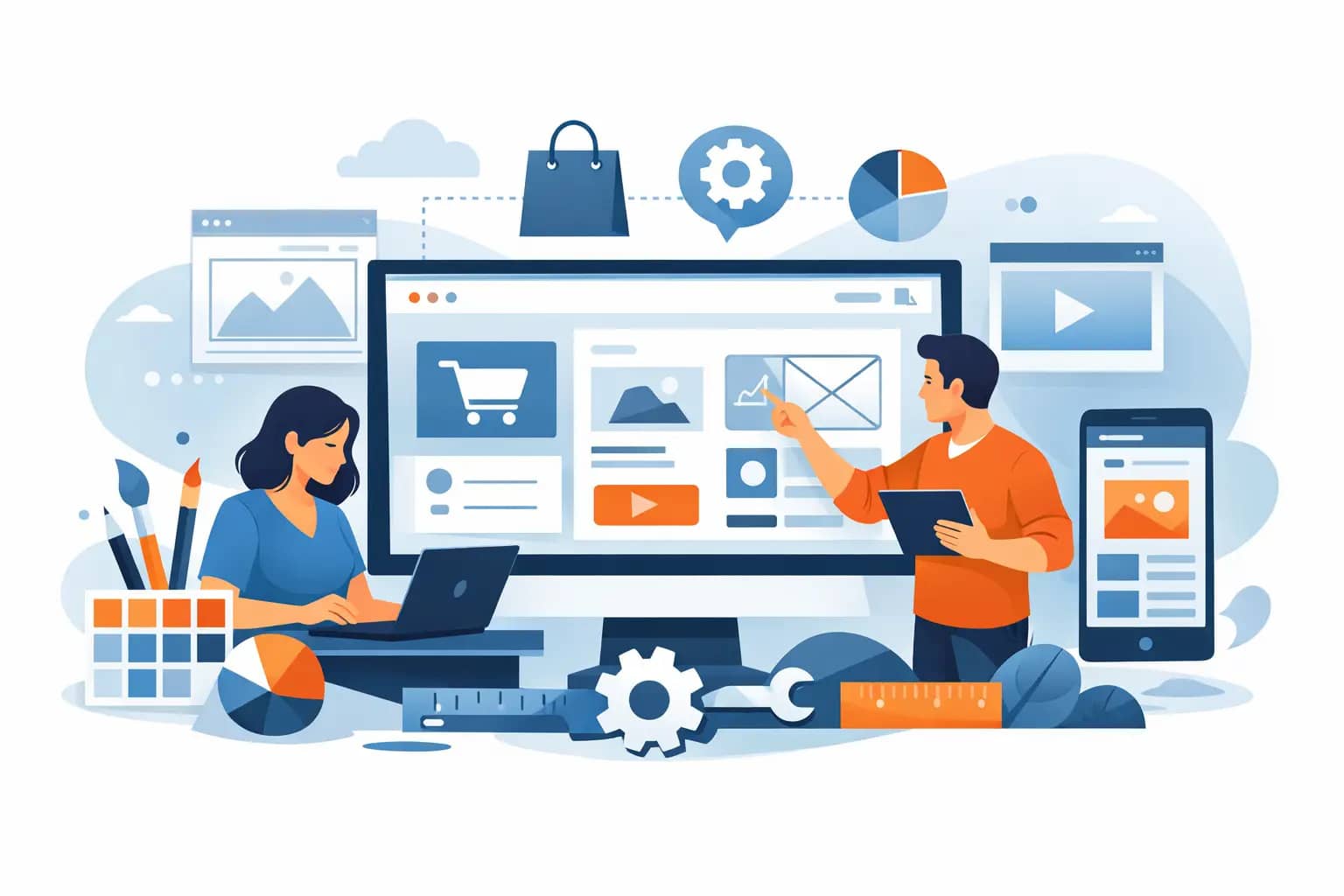
Custom ecommerce website design development creates a tailored online store built around your specific business operations, customer needs, and sales goals, rather than using generic templates that limit growth and performance.
Key Takeaways
- Template-based stores often underperform as businesses grow due to poor performance, limited flexibility, and generic user experiences that do not reflect brand identity.
- Custom ecommerce development enables integration with CRMs, ERPs, shipping systems, and payment gateways to streamline operations instead of forcing manual workarounds.
- Strategic discovery before design ensures the platform is built around actual customer journeys, regional requirements like multilingual support, and internal workflows.
- Custom solutions improve conversion rates, reduce technical debt, simplify internal processes, and enable faster campaign execution over time.
- A strong ecommerce partner provides ongoing support, optimization, and adaptation after launch rather than treating the website as a one-time deliverable.
A slow store, a confusing checkout, or a template that looks like everyone else’s can quietly drain revenue every day. That is why custom ecommerce website design development matters for businesses that expect their digital presence to support growth, not limit it. When an online store is built around your operations, customers, and sales goals, it stops being just a website and starts working like a commercial asset.
For many companies, the issue is not getting online. It is outgrowing the basic setup they started with. A template-based store may be fine for testing demand, but serious growth usually exposes the gaps quickly. Performance suffers, user journeys become cluttered, integrations feel forced, and the brand experience starts to look generic. At that point, custom development becomes a strategic decision rather than a technical preference.
Why custom ecommerce website design development changes business results
An ecommerce website has to do more than display products. It needs to guide visitors toward purchase, support marketing campaigns, handle inventory logic, connect with internal systems, and perform reliably across devices. Off-the-shelf themes can cover the basics, but they are often built for the average business, not your business.
Custom ecommerce website design development gives companies control over how the store looks, behaves, and scales. That control has direct commercial value. A business with complex product categories may need a different navigation structure than a single-brand retailer. A company selling in Kuwait and across the GCC may need multilingual support, regional payment options, delivery logic, and a checkout flow built around local customer expectations. Those needs are hard to solve well with generic templates.
The design side is just as critical as the code. Custom design allows the user experience to reflect the brand clearly, reduce friction, and build trust at the moments that influence conversion most. That includes product discovery, filtering, mobile browsing, cart review, and payment completion. Good design is not decoration. It is a sales tool.
Where template-based stores usually fall short
Templates are attractive because they reduce launch time and upfront cost. For some early-stage businesses, that trade-off is reasonable. The problem starts when the business assumes a low-cost setup will remain efficient as requirements become more specific.
One common issue is performance. Many prebuilt themes carry extra code, features, and scripts that are not needed for your store but still affect load times. Another issue is flexibility. A company may want a unique checkout sequence, custom pricing logic, or a product configurator, only to find that each change requires workarounds that make the site harder to maintain.
Search visibility can also suffer. If site structure, page hierarchy, metadata handling, and content presentation are constrained by the theme, SEO improvements become more difficult than they should be. The same applies to conversion optimization. If every store built on the same theme follows a similar layout, there is limited room to create a buying experience that reflects how your audience actually makes decisions.
That does not mean every business needs a fully custom platform from day one. It means businesses should be honest about the cost of limitation. A cheaper launch can become a more expensive rebuild if the original system was not designed for growth.
What a custom ecommerce build should include
The strongest ecommerce projects start with business requirements, not visual references alone. Before design begins, the development team should understand how the business sells, who the buyers are, what internal systems must connect, and where current friction exists.
Strategy before screens
A custom project should define the customer journey in practical terms. How do users find products? What information helps them decide? Where do they hesitate? What happens after purchase? This stage shapes the architecture of the site, from navigation and category structure to product detail pages and checkout flow.
UI and UX tailored to conversion
Custom UI and UX design allow the storefront to be built around your brand and audience rather than inherited from a template marketplace. This includes mobile-first layouts, clean product presentation, clear calls to action, and checkout experiences designed to reduce abandonment. For B2B ecommerce or hybrid business models, it may also include quote requests, account-based pricing, or restricted product access.
Development built for your operations
This is where custom work becomes especially valuable. Ecommerce development often needs to connect with CRMs, ERPs, shipping systems, payment gateways, inventory tools, and marketing platforms. A tailored build can support those workflows properly instead of forcing teams to manage disconnected systems manually.
Performance, security, and maintainability
A store that looks impressive but loads slowly or breaks during traffic spikes creates risk. Custom development should prioritize speed, code quality, security practices, and long-term maintainability. That includes clean architecture, testing, scalable hosting considerations, and a support plan after launch.
The business case for investing in custom work
Decision-makers often compare custom development to lower-cost alternatives only in terms of launch budget. That is too narrow. The better question is what the website needs to do over the next three to five years.
If ecommerce is central to your revenue strategy, the store must support brand positioning, marketing efficiency, operational accuracy, and future expansion. A custom solution can improve conversion rates, reduce technical debt, simplify internal workflows, and make campaign execution faster. Those gains are not always obvious on day one, but they compound over time.
There is, however, a trade-off. Custom projects require more planning, closer collaboration, and a higher initial investment. They also require the right partner. A weak development process can turn a custom project into an expensive delay. That is why businesses should look for an agency that can advise strategically, design thoughtfully, and develop with discipline.
For organizations in growth mode, that partner relationship matters as much as the build itself. Ecommerce is not static. Product lines change, promotions evolve, integrations expand, and customer expectations shift. The real value comes from having a team that can continue refining the platform as the business moves forward.
How to know if your business is ready
Not every company needs a custom build immediately, but several signs suggest the timing is right. If your current store is difficult to update, underperforming on mobile, limited by its theme, or struggling to integrate with core systems, custom development should be on the table. The same applies if your website no longer reflects the quality of your brand or if marketing efforts are being held back by technical constraints.
Readiness is also about internal clarity. Businesses get the best results from custom ecommerce projects when they can define goals clearly. That may include increasing online sales, supporting wholesale ordering, entering new markets, improving site speed, or creating a stronger multilingual customer experience.
When those goals are clear, the design and development process becomes more focused, and the final product is more likely to produce measurable returns.
Choosing the right development partner
A capable ecommerce partner should be able to explain more than design trends or development stacks. They should be able to connect technical decisions to business outcomes. If they recommend a platform, they should explain why it fits your transaction volume, operational needs, and growth plans. If they propose custom features, they should show how those features improve usability, efficiency, or revenue performance.
Look for a team that treats discovery seriously, communicates clearly, and plans for post-launch support. The launch is only the beginning. Real ecommerce value comes from ongoing optimization, maintenance, and adaptation.
This is where an experienced digital partner can make a meaningful difference. Agencies such as DATA approach ecommerce as part of a broader digital growth strategy, combining design, development, performance, and long-term support rather than treating the website as a one-time deliverable.
Custom ecommerce website design development is a growth decision
A business website should not be a constraint hidden behind attractive visuals. It should be a high-performing system built around how your company sells and how your customers buy. Custom ecommerce website design development gives businesses the flexibility to create that system with precision, whether the priority is better conversion, stronger branding, more efficient operations, or readiness for future expansion.
The most effective ecommerce platforms are not the ones with the most features. They are the ones built with the right features, the right structure, and the right long-term thinking. If your current store is starting to hold your business back, that is usually the clearest sign that custom work is no longer optional. It is the next practical step forward.

